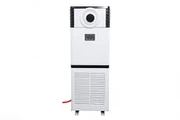
Principle and structure of air source heat pump water heater
Aug 19, 2024
Air source principle:
The air source water heater uses refrigerant as a medium. The refrigerant absorbs the heat in the ambient air and then vaporizes. It is compressed by the compressor to generate heat and becomes a high-temperature and high-pressure gas. After exchanging heat with water through the heat exchanger, the pressure is released through the expansion valve and returns to the low-temperature and low-pressure liquefied state. Through the continuous circulation of the refrigerant, it continuously absorbs low-grade heat in the air and transfers this part of the heat to produce hot water.
In nature, water always flows from high to low, and heat always transfers from high temperature to low temperature. But people can use a water pump to lift water from low to high, to realize the flow of water from low to high. The heat pump can also transfer heat from low temperature to high temperature. Therefore, the heat pump is essentially a heat-lifting device. The function of the heat pump is to absorb heat from the surrounding environment and transfer it to the heated object (the object with a higher temperature). Its working principle is the same as that of the refrigerator. They all work according to the reverse Carnot cycle. The only difference is that the working temperature range is different.
Air source structure:
A compression heat pump device mainly consists of four parts: evaporator, compressor, condenser, and expansion valve. It allows the working fluid to continuously complete the thermodynamic cycle of evaporation (absorbing heat from the environment) → compression → condensation (releasing heat) → throttling → re-evaporation, thereby transferring the heat in the environment to the water.
When the heat pump is working, it absorbs the energy QA stored in the environmental medium in the evaporator; it consumes part of the energy itself, that is, the power consumption of the compressor QB; it releases heat QC in the condenser through the working fluid circulation system, QC=QA+QB, from which it can be seen that the energy output by the heat pump is the work done by the compressor QB and the heat absorbed by the heat pump from the environment QA; therefore, the use of heat pump technology can save a lot of electricity. Compared with the boiler (electricity, fuel) heating system, boiler heating can only convert more than 90% of the electricity or 70-90% of the fuel's internal energy into heat for users.